Aurélia’s Oratorio is coming back! This show played to sold-out houses this winter, so if you weren’t able to get a ticket then, now is your chance. Aurélia will be back at the Loeb for just two weeks, July 22 – August 2.
Here is a repost of the two-minute trailer that gives you a glimpse into the magic of Aurélia’s enchanting topsy-turvy world. Learn more on our website.
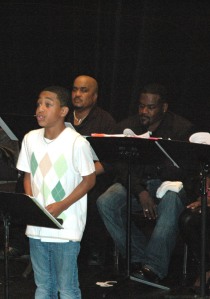
Several of us from the A.R.T. trekked down to the big apple yesterday for the presentation at the end of a one-week workshop kindly hosted by the folks at The Public Theater. The cast – which all of us present hope will be the one that will come to Cambridge – was assembled in front of their scores, with a pianist and a conductor. Diane made a brief speech, and the music began…. and WHAT a ride it was! The cast was phenomenal, voices ranging from the big handsome Philip Boykin singing the role of the King with the deepest bass baritone voice to the absolutely adorable 12-year old Chris Borger, who not only sounds like an angel, but performed with the poise and the self-assurance of a total pro. And the amazing Lavon Fisher-Wilson, who brought the house down with her “let a little sunshine in”…. we were practically dancing in the aisles. And… last but not least, there was “Big Daddy” himself, David Alan Grier, a sort of master of ceremonies, story teller, who tied all the proceedings together with a great sense of humor and improvisation. I was not familiar with the music of composer Deirdre Murray, but I could not sit still, totally enveloped in the rhythm, the buoyancy and enthusiasm of the cast, and those voices!!!! I cant wait for rehearsals to begin here in Cambridge in the fall…
I’m writing from the first night of tech rehearsal. Sitting inside rehearsal rooms for the past few weeks, I had no concept of just how enormous the scale of our production is. Mamet’s plays are typically performed on unit sets with simple lighting instruments, set pieces, and props. Our version of Romance uses a string of giant moving set pieces, gyroscoping lights, stage blood, and smoke machines. At first glance, this gear is better suited to a rock concert than a Mamet play.
But once we began running sequences from the show, I realized just how well the massive scale of our productions meshes with the ambitions of Mamet’s text. The A.R.T. is known for Mamet works like Oleanna, a realistic, two-character piece that takes place in a tiny office. But Romance is a larger-than-life farce. Actors throw roasting pans and insults across the courtroom with reckless abandon. We’ve thrown in plenty of tricks, zany sound effects, and even a strip-tease or two.
Scott’s staging also takes advantage of one of the text’s greatest strengths: a great sense of farcical acceleration. At first glance, the play’s opening scene is nearly free of farce. It could easily be a scene from this week’s episode of Law and Order. Slowly but surely, Mamet tightens the screws. Polite disagreement turns into schoolyard name-calling. A wisecracking judge becomes a pill-popping maniac. An ordered courtroom descends into comic chaos.
pARTy 2009: Artistic Director Diane Paulus, Founding Director Robert Brustein, Actress Diane Lane.
The A.R.T.’s annual fundraiser pARTy let the sun shine on Monday, April 27, when Artistic Director Diane Paulus was joined by special guests including members of the cast from her Broadway production of HAIR to help celebrate the dawning of a new era at the A.R.T.
Other groovy people of the night included actress Diane Lane, Joyce Kulhawik, and Billy Costa. The annual Robert Brustein Award was presented to internationally acclaimed director Andrei Serban and A.R.T. Senior Actor Jeremy Geidt.
The evening left hippie-clad guests dancing onstage and in the aisles after a rollicking performance by the Broadway cast of HAIR.
The event was a tremendous success thanks to the generosity of the A.R.T.’s friends, board members, and supporters.
All through this season at the A.R.T., I’ve been pondering Romance while working on other projects. I’ve made it a point to try and re-read the text at least once a week. Back in January, I sat down for another trip through the play as President Obama’s inauguration played on a nearby TV. When I finally put two and two together, I grabbed a post-it and frantically scribbled a note: “This changes everything for Romance.” How could a farce that mocks our social differences succeed in an era of supposed unity?
Two weeks of rehearsal has calmed my fears. Hearing our cast deliver the play has reminded me that it is the ultimate equal-opportunity offender. Mamet goes out of his way to poke fun at every race, religion, sexual orientation, profession, nationality, and political viewpoint. I often have the image of Mamet sitting beside a list of special interest groups, checking each one off as he created the play’s dialogue. In fact, the Romance team created our own list of those lambasted in the play. It is an exhaustive list.
Writing these blog entries as I watch the news, I’m reminded that we may not be as united as we’d like to believe. The current string of tea-bag protests and the Texas governor’s threats of secession may be taken as humorous here in Boston, but this division is precisely what Mamet inflates and capitalizes on in Romance. He dares us to laugh at our differences, detonating our national traditions of political correctness and censored speech.
The technique has become a hallmark of Mamet’s work after Romance. His most recent Broadway hit November decimates the sanctity of the Oval Office, presenting the fictitious president as a swindling crook and anti-hero. Mamet turns the political speech into the stuff of farce in November, just as Romance mocks “legalese” lawyer-speak. If Mamet advocates for anything in these farces, it is for us to take ourselves less seriously.